
Solid Body Classics, Vintage Electric Guitars
The Guitar That Started It All: A 1952 Gibson Les Paul Goldtop

Aug
There are vintage guitars you admire from across the room, and there are vintage guitars you can’t wait to plug in. This 1952 Gibson Les Paul Goldtop is definitely the latter.
We picked this one up from its original owner, who bought it new in the early ’50s and spent a lifetime making music with it. That’s exactly the kind of story we love. This isn’t a time capsule, it never lived under a bed or in a bank vault. It was somebody’s guitar, and it wears those years proudly.
The finish has all the right kind of wear, the neck feels perfectly broken in, and the P-90s have that unmistakable early Gibson magic that keeps players chasing these guitars over seventy years later.
The Original Goldtop

Before Tune-o-matics, before humbuckers, before flame maple tops became the norm, there was the original Les Paul. A carved maple top, a solid mahogany body, a big comfortable neck, and two incredible P-90 pickups.
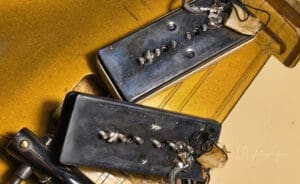
If you’ve never spent time with a great set of ’50s P-90s, you’re in for a treat. They’re thick without being muddy, clear without being brittle, and incredibly touch-sensitive. Dig in and they bark with a natural growl. Ease up and they clean right up, almost like the guitar is reading your hands.
There’s a reason so many players swear by these pickups. They have a fullness and harmonic richness that’s hard to find anywhere else, making this Goldtop just as happy playing blues, country, rock ‘n’ roll, or jazz as it is pushing a cranked tweed amp into glorious overdrive.
A Player’s Goldtop

One of the quirks of the very first Les Pauls is the original trapeze bridge. Historically important? Absolutely. The best playing design Gibson ever came up with? Not exactly.
This guitar has been upgraded with a MojoAxe conversion bridge, and if you’ve spent any time around early Goldtops, you know why that’s such a welcome addition. Designed specifically for the shallow neck angle found on 1952 Les Pauls, it dramatically improves the feel, intonation, and overall playability while keeping the original look intact.
The original trapeze tailpiece is included in the case, but the MojoAxe lets this guitar do what it was always meant to do, be played.
Restored the Right Way
Like many guitars that have been played for more than seventy years, this Goldtop has had a little help along the way.
It came to us with a partial headstock break. The repair was expertly carried out by Gil Chavez of Valley Arts fame, including touch-up work to the repaired crack and the small black finish chips around the headstock. It’s structurally solid and exactly the kind of honest repair you’d expect to see on a guitar that’s lived a full life.

While the guitar was with Gil, it also received the attention that makes it such a great player today. The frets were leveled and dressed, the fingerboard cleaned up, and the guitar was given a complete professional setup.
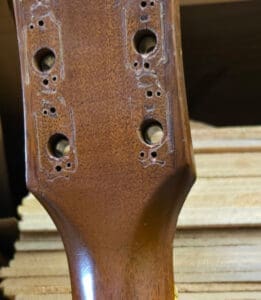
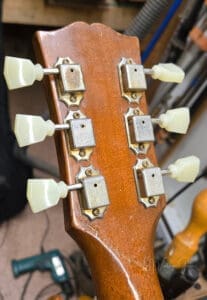
The original owner had replaced the factory tuners with Grovers years ago, but those have since been swapped for relic’d Kluson tulip tuners that return the guitar to a much more period-correct look while neatly covering the extra mounting holes left behind.

The electronics were refreshed using a correct 1952 wiring harness with proper vintage-style tubing, the original Grey Tiger paper-in-oil capacitors, and a NOS Switchcraft output jack.
None of this was done to make the guitar look new. It was done to make sure it plays, sounds, and functions exactly the way a great vintage Les Paul should.
Honest Wear You Can’t Fake


This Goldtop has decades of natural wear that only comes from thousands of hours in someone’s hands. The finish checking, worn edges, and smooth neck all tell the story of a guitar that has been played consistently since it left the factory.


It’s the kind of wear that collectors appreciate because there’s no mystery behind it, just years of honest use.
Why Players Love Early Goldtops

The best vintage guitars have a way of making you play differently.
This one is incredibly lively acoustically, and once it’s plugged in, everything starts to make sense. The P-90s are full, warm, and wonderfully dynamic. They clean up beautifully with the volume knob, but lean into them a little harder and they reward you with the kind of natural compression and overdrive that made these guitars famous long before humbuckers came along.
It’s one of those guitars that feels alive in your hands.
Original Case Included


The original Gibson hardshell case is included and still accompanies the guitar today, complete with its replaced handle from decades of faithful service. There’s even a note written to a fan on it from the original owner when he briefly parted with the case before re-aquiring it.
Also included are the original trapeze tailpiece and the original control knob, giving the next owner every piece of the guitar’s story.
From 1952 Goldtop to ’57 Conversion


We love museum-quality guitars, but we have a real soft spot for instruments like this.
This started life as an honest, player-grade 1952 Gibson Les Paul Goldtop. It has been loved, played, repaired, and thoughtfully maintained for more than seven decades. Today, it has been taken a step further and converted into a 1957-style Les Paul, giving this early Goldtop an entirely different voice and look while retaining the character and history of the original guitar.
The conversion now features real PAF humbuckers, a stopbar tailpiece, and an ABR-1 bridge, bringing the guitar much closer to the feel and sound of a late-’50s Les Paul. The combination of an early-’50s Goldtop foundation and genuine late-’50s Gibson hardware and pickups makes for a pretty special instrument—one with the soul of a vintage Goldtop and the punch and authority of a ’57.
This conversion is currently available through Black Magic Guitars.
It’s a great example of why we love vintage guitars in the first place. These instruments don’t always have to remain frozen in the exact configuration in which they left Kalamazoo. Sometimes, the fun is in taking a great old guitar and giving it a new chapter.
For an in-hand description or more information on the current conversion, please contact John at Black Magic Guitars.

